
LNG Infrastructure Opportunity: The Fuel Behind the Next Generation of Energy Demand
As global energy demand accelerates, LNG infrastructure is emerging as a critical solution for data centers, distributed power generation, and industrial operations—bridging gaps where traditional infrastructure cannot keep pace.
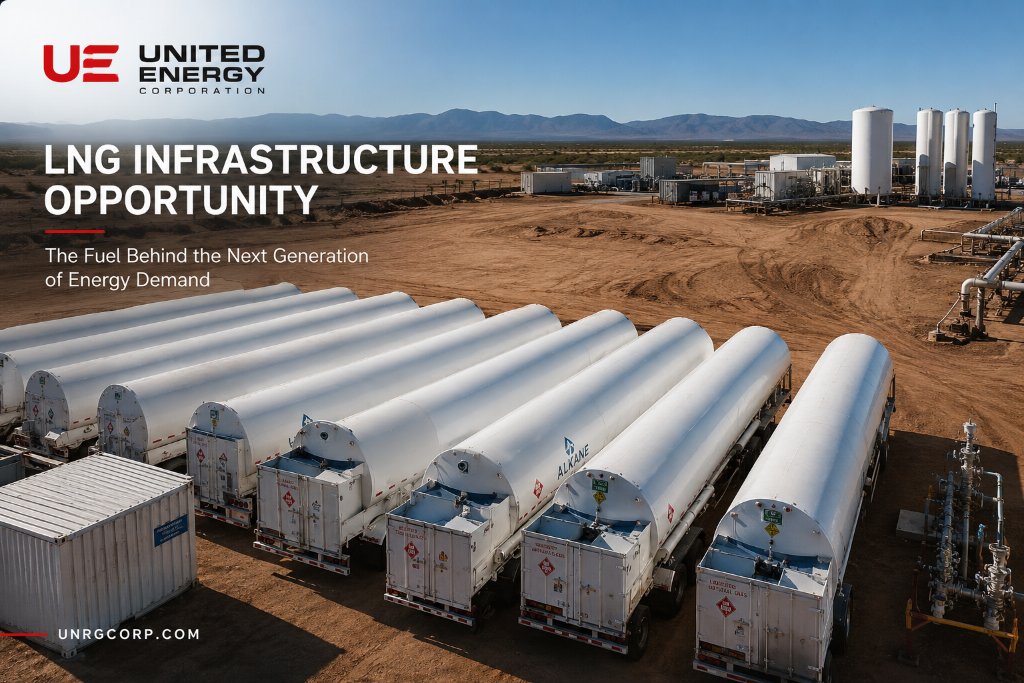
LNG Infrastructure Opportunity
As global energy demand continues to rise, a new infrastructure challenge is emerging. The industries driving economic growth—including artificial intelligence, advanced manufacturing, industrial development, and energy-intensive operations—require reliable power delivered at unprecedented scale.
The question is no longer whether energy demand will grow.
The question is whether infrastructure can keep pace.
Among the solutions attracting increasing attention from utilities, industrial operators, data center developers, and energy investors is liquefied natural gas (LNG).
While LNG has traditionally been associated with export markets and large-scale energy projects, its role is rapidly expanding. Today, LNG is becoming an increasingly important component of distributed energy systems, temporary power deployments, industrial fuel supply, and infrastructure projects requiring reliable energy access.
The Growing Energy Demand Challenge
The energy landscape is changing faster than traditional infrastructure development cycles.
Large data centers can require hundreds of megawatts of power. Industrial facilities continue to expand. Population growth and electrification initiatives are increasing overall demand on transmission and distribution systems.
At the same time, utility interconnection timelines have lengthened across many regions.
Projects that once expected power availability within months are increasingly facing multi-year development schedules.
This gap between energy demand and energy availability is creating new opportunities for alternative energy infrastructure solutions.
Why LNG Matters
Natural gas remains one of the most widely available and scalable energy resources in North America.
When cooled to approximately -260°F, natural gas becomes a liquid, reducing its volume dramatically and making transportation and storage significantly more efficient.
This allows LNG to be transported to locations where pipeline infrastructure may be unavailable, constrained, or economically impractical.
For many operators, LNG provides flexibility that traditional infrastructure cannot always offer.
Potential applications include:
- Distributed power generation
- Temporary power deployments
- Data center support infrastructure
- Industrial operations
- Remote facilities
- Peak demand management
- Emergency energy supply
- Utility support services
As energy requirements continue to evolve, LNG's ability to bridge infrastructure gaps is becoming increasingly valuable.
Data Centers and the Search for Power
Perhaps no sector illustrates the opportunity more clearly than data centers.
Artificial intelligence, cloud computing, and digital infrastructure continue to drive unprecedented demand for electrical capacity.
Developers are competing for available power across major markets, while utilities work to balance growing demand with long-term grid planning requirements.
For some projects, waiting years for additional transmission capacity is not commercially viable.
As a result, developers are increasingly evaluating distributed generation strategies, behind-the-meter power systems, and alternative energy infrastructure capable of supporting operational timelines.
LNG can play an important role within these energy strategies by providing fuel supply for generation assets deployed closer to the point of consumption.
Industrial Infrastructure Requires Reliability
Energy-intensive industries have always prioritized reliability.
Manufacturing facilities, mining operations, aggregates producers, oil and gas operators, and remote industrial sites all depend on continuous access to fuel and power.
Operational disruptions can result in significant costs, delayed production, and supply chain challenges.
For these operators, LNG offers a scalable solution that can be deployed in regions where traditional infrastructure may be limited or unavailable.
This flexibility allows businesses to maintain operational continuity while supporting growth initiatives and long-term development plans.
The Value of Integrated Infrastructure
As energy systems become more complex, infrastructure operators increasingly recognize the value of integration.
Fuel supply, logistics, storage, transportation, field operations, and power generation are often managed by separate providers.
Coordinating multiple vendors can create operational inefficiencies, scheduling challenges, and accountability gaps.
Integrated infrastructure platforms seek to simplify these processes by aligning multiple components of the energy value chain under a unified operating model.
As distributed energy adoption continues to grow, integrated approaches may become increasingly important to delivering reliable energy solutions at scale.
Looking Ahead
The future of energy infrastructure will require a combination of traditional utility investment, grid modernization, generation expansion, and innovative deployment models.
LNG is not a replacement for the grid.
It is a complementary infrastructure solution that can help address energy delivery challenges, support economic development, and provide operational flexibility where conventional infrastructure may face limitations.
As demand for reliable energy continues to accelerate, LNG infrastructure is positioned to play a meaningful role in supporting the next generation of industrial growth, digital infrastructure, and distributed energy development.
Conclusion
The energy transition is often discussed in terms of generation technologies, but infrastructure remains the foundation of every energy system.
Fuel must be produced, transported, stored, delivered, and converted into usable power.
LNG infrastructure provides an important link within that chain.
For investors, operators, developers, and energy stakeholders, understanding the role of LNG infrastructure is becoming increasingly important as energy demand continues to expand and reliability becomes a competitive advantage.
Explore LNG Infrastructure Solutions
Interested in learning more about LNG infrastructure, distributed power, and energy fulfillment solutions? Explore additional resources or contact United Energy for more information.